Colorbond Steel Fencing Cost per Meter Installed: Instance Researches
Colorbond fences have a tidy look, a long service life, and fewer headaches than timber. That part is straightforward. What often surprises homeowners is how much the final number can move, even on short runs. The difference between a dead flat suburban boundary and a sloping, rooty side return with a telegraph pole in the way can easily double the Colorbond fencing price per meter. If you are budgeting without considering ground conditions, wind rating, sleepers, and access, the quote you like on paper can unravel on site.
I install and scope fences for a living. The following breakdowns and case studies use numbers I see on actual jobs rather than brochure averages. Treat them as practical bounds, not promises. Regional markets vary, product lines change, and delivery surcharges have a habit of arriving late in the piece. Still, these examples will help you read a quote, compare apples with apples, and decide where to spend and where to save.
What “price per meter installed” usually includes
Most installers express a Colorbond steel fence price per meter as a turnkey figure for straight runs. That typically covers:
- Panels, posts, rails, caps, and standard fixings in a common profile and colour
- Post holes and concrete footings at the recommended depth for your wind region
- Basic string line setout and standard cuts at ends
- Labour and GST
The Colorbond steel fencing cost per meter does not always include gates, retaining plinths or sleepers, demolition and disposal of an old fence, rocky or hand-dug footing allowances, or premium coastal hardware. Corners, rakes on steep sections, and tricky interfaces with sheds or pools may carry lump sum extras rather than a simple per meter rate.
Baseline ranges to orient your budget
For common metro, non cyclonic conditions, level ground, easy access, and a 15 to 40 meter run, the following installed ranges are typical for good quality, brand name materials:
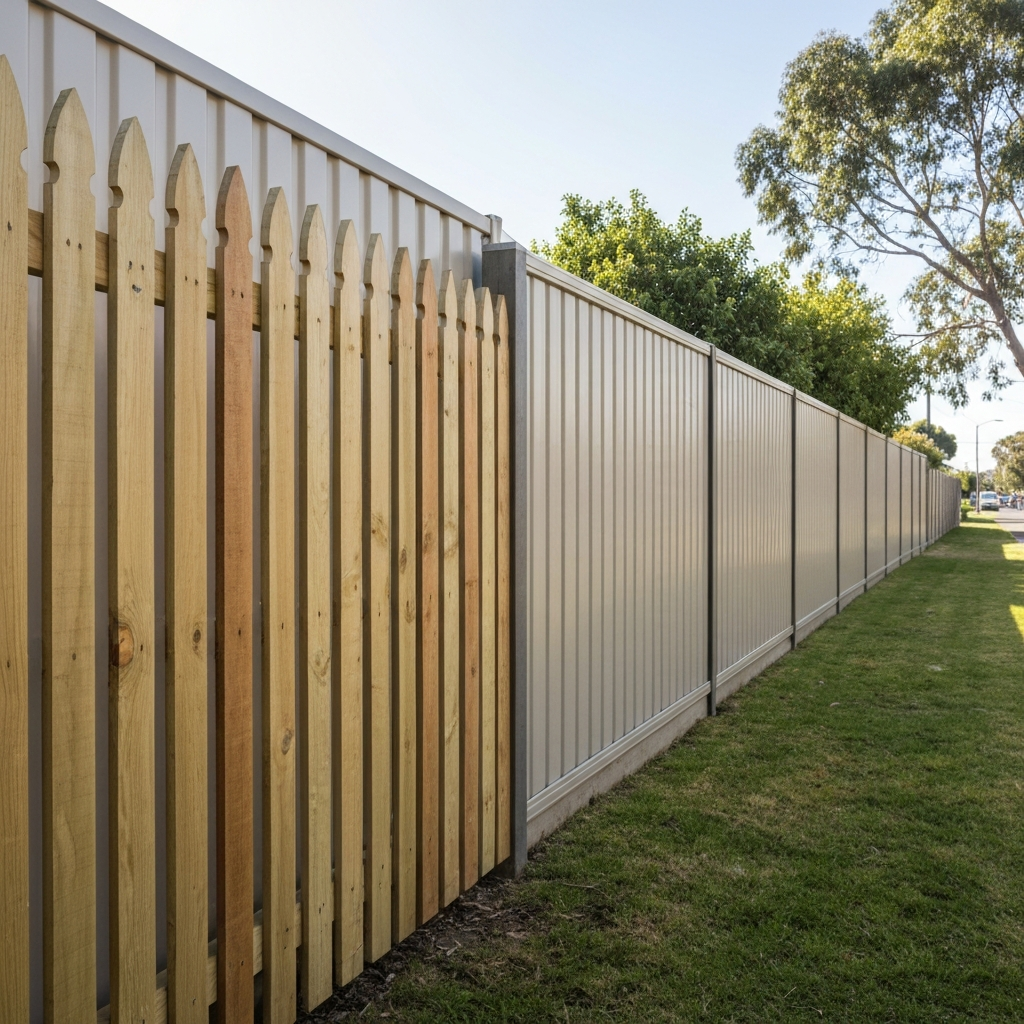
- 1.5 m high: $85 to $125 per meter installed
- 1.8 m high: $95 to $140 per meter installed
- 2.1 m high: $140 to $220 per meter installed
Short runs below 12 meters often sit above these ranges because fixed costs get spread over fewer meters. Runs above 50 meters may attract a better rate if access is simple and the layout is clean.
Gates, plinths, and region-specific extras change the picture quickly:
- Single pedestrian gate: $350 to $700 installed depending on frame, hardware, and height
- Double driveway gate: $950 to $2,200 installed for manual swing, more for automation-ready frames
- Steel or composite plinths to block gaps at the base: add $45 to $90 per meter
- Concrete sleeper retaining integrated with the fence: add $120 to $220 per meter for modest falls, more with engineering or tall retained heights
- Coastal grade fixings and marine coatings: add $6 to $15 per meter
Disposal of a tired timber fence, including posts and footings, usually falls between $20 and $45 per meter. A skip bin for a medium run is commonly $350 to $600, sometimes built into the quote as a line item.
Typical installed price by height and context
The table below summarises practical installed ranges for standard profiles in non cyclonic metro conditions with simple access. These assume straight runs, no gates, no sleepers, and no demolition.
| Height | Typical installed range per meter | Notes | | --- | --- | --- | | 1.5 m | $85 to $125 | Often used on front boundaries and side returns | | 1.8 m | $95 to $140 | Most common backyard privacy height | | 2.1 m | $140 to $220 | Heavier posts and deeper footings push costs up |
Regional uplift in cyclone-prone parts of QLD and WA, or rural areas with long travel times, can add 10 to 30 percent to these ranges. Conversely, large, easy runs in competitive metro markets may shave 5 to 10 percent.
What actually drives your Colorbond fence cost
Installers look at a site and quietly assess eight or ten levers that will shift the Colorbond fence price. If you understand them, you can predict where your quote will land.
- Height, wind region, and footing depth. Taller fences and higher wind ratings require heavier posts and more concrete, both of which push the Colorbond steel fencing price per meter upward.
- Ground conditions. Clean soil is quick. Rock, roots, buried rubble, and services turn every post hole into a chore. Hand digging and jackhammer time cost real money.
- Slope and retaining. Colorbond is modular. On a slope you either step it, rake it, or retain beneath it. Each path has a cost implication.
- Access. Wheelbarrows and panel trolleys through a back lane are fine. Three flights of stairs through a townhouse and a 25 meter carry is not.
- Extras and terminations. Corners, returns, non standard gaps against sheds, pool panels that must meet local codes, and custom colours or profiles all add up.
Keep those forces in mind as you read the case studies below. They show how seemingly small details alter the Colorbond fencing price per meter.
Case study 1: Straight suburban side boundary, 30 meters, 1.8 m height
Location: Inner west Sydney, flat block with driveway access to the side return.
Scope: Remove old timber palings and install a standard 1.8 m Colorbond profile in a common colour. No gates, no plinths, two corners.Materials and plant:
- 17 panels at 1.76 m modules, 16 posts, rails, caps, and standard fixings
- 20 MPa premix concrete for 16 holes at 600 mm depth
- Skip bin for demolition
Time and labour: Two installers, one and a half days including demolition and clean up.
Costs observed on invoice:
- Supply of panels, posts, rails, caps: $2,350
- Concrete and consumables: $260
- Skip bin and disposal: $420
- Labour and overhead: $1,480
- GST: $451
Total: $4,961 for 30 meters.
Effective Colorbond fence price per meter installed: about $165 including demolition, or about $150 without disposal.Why it landed here: Demolition and disposal pushed the number above the neat 1.8 m baseline. Access was good, so labour stayed efficient. The corners were standard and did not require custom posts.
Takeaway: If you already split demolition with a neighbour or handle it yourself, expect the Colorbond fencing price per meter to sit closer to $120 to $140 for a similar run in the same market.
Case study 2: Sloping block with integrated retaining, 45 meters, 1.8 m height with sleepers
Location: Outer Melbourne, modest slope falling 500 mm over the length of the boundary.
Scope: Install 1.8 m panels stepped with a 200 mm concrete sleeper at the base along 35 meters of the run. Ten meters at the top were near level with no sleepers.Materials and plant:
- Standard panels and posts for 45 meters
- Heavier posts and deeper footings where sleepers were used
- Precast concrete sleepers, galvanised channel sections
- Extra concrete and reinforcement for retained sections
Time and labour: Two installers, three days. Sleeper alignment and compaction ate time.
Costs observed on invoice:
- Panels, posts, rails, caps: $3,480
- Sleeper system and steel channels: $3,050
- Concrete, reinforcement, aggregate delivery: $640
- Labour and overhead: $3,150
- GST: $1,032
Total: $11,352 for 45 meters.
Effective Colorbond steel fence price per meter installed: about $252.Why it landed here: The retaining component is the big lever. Even a modest 200 mm sleeper under most of the run meant heavier posts, more digging, more concrete, and extra handling time. On steeper blocks, this uplift is unavoidable if you want a neat, gap-free base and tidy stormwater control.
Takeaway: If your site needs even small retaining, add $120 to $200 per meter to any baseline Colorbond fencing cost, more if the retained height exceeds 400 mm or the soil is wet and collapsible.
Case study 3: Coastal upgrade, 22 meters, tight access courtyard
Location: Fremantle, three terrace homes sharing narrow rear laneways.
Scope: Replace a rusted low fence with a 1.5 m Colorbond fence in a sea breeze corridor, with coastal grade stainless fasteners and thorough washdown access planned.Materials and plant:
- 1.5 m panels, posts, rails, caps
- Stainless steel fixings and marine grade rivets
- Small batch concrete mixed on site due to access
- Trolleys and mats to protect pavers
Time and labour: Two installers, two days. Slow carry in and out, constrained working space.
Costs observed on invoice:
- Panels, posts, rails, caps: $1,920
- Coastal grade fixings and consumables: $210
- Concrete and mixing gear hire: $140
- Labour and overhead: $2,050
- GST: $443
Total: $4,763 for 22 meters.
Effective Colorbond fence price per meter installed: about $216.Why it landed here: The coastal spec added less than $10 per meter in materials, but access and handling time doubled the labour component. Pavers slowed movement, and we had to mix concrete on site, which never helps productivity.
Takeaway: When you cannot stage panels close to the workface or bring in premix, the Colorbond steel fencing price per meter jumps into a new bracket. Plan for it, and do not skimp on coastal fasteners. Cheap screws will bite you within a couple of years.
Case study 4: Cyclonic region, 36 meters, 1.8 m height with wind-rated footing details
Location: Townsville suburban block.
Scope: Replace a failed timber fence with a wind-rated Colorbond system, heavier posts, deeper footings, and cyclone region compliant spacing. No gates, two corners, flat ground.Materials and plant:
- Rated posts and rails per region
- Standard panels, compatible fixings
- Deeper concrete footings and bar chairs
- Removal and disposal of old fence
Time and labour: Three person crew, two days, due to the number of deeper holes.
Costs observed on invoice:
- Materials including heavy posts and rails: $4,420
- Concrete, reinforcement, and delivery: $760
- Demolition and disposal: $680
- Labour and overhead: $3,180
- GST: $905
Total: $9,945 for 36 meters.
Effective Colorbond steel fencing price per meter installed: about $276.Why it landed here: Wind region upgrades put weight into both steel and concrete. You also spend more time on setout to ensure compliance. In cyclone prone zones, a $200 to $300 per meter figure is normal for 1.8 m height, especially when demolition is included.
Takeaway: Do not chase bargain rates in high wind areas. Your insurer and your peace of mind both prefer a fence that stays put.
Case study 5: Long rural run, 120 meters, straightforward access, shared boundary
Location: Peri urban Adelaide fringe, gently rolling pasture, open access for ute and trailer.
Scope: Install a 1.8 m Colorbond boundary fence along 120 meters, shared with a neighbour. No gates, two corners, no demolition.Materials and plant:
- Bulk order panels, posts, rails, caps
- Concrete delivered in two drops near the workface
- Auger on a small skid steer to speed hole boring
Time and labour: Three installers, three days. Efficient production line conditions.
Costs observed on invoice:
- Bulk materials: $8,750
- Concrete and delivery: $1,120
- Machine hire and fuel: $480
- Labour and overhead: $5,220
- GST: $1,565
Total: $17,135 for 120 meters.
Effective Colorbond fencing price per meter installed: about $143.Why it landed here: Access and scale help. With long straight lines and no obstructions, production rates climb and per meter labour falls. The neighbour split the bill, which also made the decision easier for both parties.
Takeaway: If you have a long, clean run, ask for a scaled rate. Installers appreciate predictable work and will price accordingly.
Case study 6: Short urban replacement with a gate, 12 meters, 1.8 m height
Location: Brisbane inner north, two terraces.
Scope: Remove 12 meters of decayed timber, install 1.8 m Colorbond, add a 970 mm pedestrian gate with lockset.Materials and plant:
- Standard 1.8 m panels, posts, rails
- One gate leaf, posts, and hardware
- Concrete, consumables, small skip
Time and labour: Two installers, one day.
Costs observed on invoice:
- Panels, posts, rails: $980
- Gate leaf, frame, posts, hardware: $540
- Concrete and consumables: $120
- Demolition and disposal: $260
- Labour and overhead: $980
- GST: $288
Total: $3,168 for 12 meters plus a single gate.
Effective Colorbond steel fence price per meter installed: about $183 if you include the gate cost across the whole run, or about $153 per meter for the fence portion plus $594 for the gate as its own item.Why it landed here: Short runs carry fixed costs, and the gate hardware and frame are lumpy items. For urban jobs like this, a Colorbond fence installer price per meter will rarely match longer run rates.
Takeaway: When scoping small work, ask for the gate as a separate line so you can compare the fence-only rate with larger jobs you see online.
Regional price patterns you can expect
- Sydney and Melbourne metros show dense competition, efficient supply chains, and ready access to crews. Baseline Colorbond fence price per meter for 1.8 m height on simple sites often sits between $110 and $150, higher with demolition.
- Brisbane and SEQ vary with weather and access. Many quotes cluster between $115 and $160 per meter for 1.8 m, excluding gates and sleepers, with brief spikes after storms or wet periods.
- Perth pricing is sensitive to delivery zones and labour availability. Expect $120 to $170 per meter in the suburbs for straightforward 1.8 m runs, with coastal hardware and access adding to that.
- Adelaide tends to be moderate. $105 to $145 per meter is common on simple work, with good value on longer runs.
- Hobart and regional Tasmania incur freight and travel. $125 to $180 per meter is a fair band for 1.8 m height, more if the job is remote.
- Cyclone regions in QLD and WA are their own category. $200 to $300 per meter is typical for compliant 1.8 m work that includes deeper footings and heavier steel.
These are observed bands, not quotes. Supply spikes, labour shortages, and fuel prices move them around.
What installers notice during a site visit
A tidy sketch from a homeowner is helpful, but a walk around the site tells the real story. A few details that matter more than most:
- Services near the line. Irrigation lines, shallow electrical conduits, or telecom cables slow digging and force hand work. Meter rates rise with risk.
- Neighbour relations. If both sides agree on height, colour, and line, the work goes faster. If there is a dispute about the boundary or style, delays and rework eat margin, and installers price for that uncertainty.
- Trees and roots. A single large stump can add hours of digging and concrete management. It might move a neat $120 per meter quote into the $150s.
- Stormwater paths. A gap under a fence lets water move off your land. If you block it with sleepers or plinths, you need to plan where water goes, or you risk blowouts during heavy rain.
- Corners and setbacks. Every corner breaks rhythm. Near a pool or structure, the fence may need to meet local regulations, which can require specific heights, clearances, or non climbable rails.
These are not gotchas. They are the practical parts of the job that a seasoned Colorbond fence installer will price into the Colorbond steel fence installer cost so there are no surprises on install day.
A simple checklist to predict your Colorbond fencing cost
- Height, total length, and any gates with widths
- Slope in millimetres over each run and any retaining or plinth needs
- Ground type: clean soil, fill, rock, or roots, and known services
- Access path for materials, parking, and spoil removal
- Region specifics: coastal hardware, wind rating, or heritage colour limits
Share these details upfront and you will get tighter, more comparable figures for the Colorbond fencing price per meter.
Breaking down where the money goes
On a standard 1.8 m suburban run, the Colorbond fence installer cost has a few predictable buckets.
- Materials. For common colours and profiles, panels, posts, rails, and caps usually land between 45 and 60 percent of the quote. Heavier posts, sleepers, or custom colours lift that share.
- Concrete and consumables. Five to ten percent, more if footings are deep and soil is loose.
- Labour and overhead. Thirty to forty percent. Short runs or bad access push this higher because setup and travel are fixed.
- Disposal and incidentals. Five to ten percent. Old timber, buried concrete, or surprise brick footings eat this quickly.
On short jobs, overhead takes a fatter slice per meter because you still need to send a crew and truck, set lines, and clean up.
How to compare quotes without getting burned
Two quotes that look similar on a per meter basis can be miles apart Great post to read in scope. Use the steps below to force clarity before you approve anything.
- Ask for the fence, gates, demolition, and sleepers as separate lines so you can see the Colorbond fence price per meter for the fence alone.
- Confirm the post spacing, footing depth, wind region assumptions, and fastener grade in writing.
- Specify the exact profile and colour range. Not all panels are the same gauge or coating system.
- Check the access plan, spoil removal, and who pays for unforeseen rock or buried rubble.
- Request a warranty statement for materials and workmanship with time periods and what voids them.
If all of that is clear, you can compare the true Colorbond steel fencing installer price for your scope and avoid change orders later.
DIY versus hiring a pro
Colorbond is modular, and experienced DIYers do complete small runs well. You can buy panels at retail and rent an auger. The supply only Colorbond steel fence price per meter for 1.8 m height is commonly $55 to $85 depending on quality, colour, and where you buy. Add concrete, post caps, fasteners, and tools, and you might build for $70 to $110 per meter in materials. If your time is free and the ground is friendly, that is compelling.
The catch appears with slope, rock, wind ratings, and gates that need to hang perfectly. Professionals own the tools, know how deep to chase for each soil type, and, more importantly, price in compliance and warranty. If you value a straight top line, plumb posts, and a fence that stays tight through its first winter, the Colorbond fencing installer cost often pays for itself.
Small decisions that save money without regret
- Standard colours. Common colours are often in stock and cheaper. Custom colours add lead time and price without improving function.
- Share boundaries. Split cost with neighbours and agree on a common height. Two 30 meter jobs cost more than one 60 meter job done in one visit.
- Avoid unnecessary sleepers. If privacy is fine and water flows under a small gap, consider a steel plinth instead of full concrete sleepers. You may save $70 to $120 per meter.
- Plan gates carefully. One well placed pedestrian gate is often enough. Doubling up on gates increases both material and labour for marginal benefit.
- Book off peak. Installers are busiest in the dry months and after storms. If your timing is flexible, ask whether a shoulder season slot improves the Colorbond fencing price.
Timelines and disruptions to expect
A 20 to 30 meter simple run usually completes in a day to a day and a half. Add a second day if you have demolition, sleepers, or multiple gates. Concrete sets quickly, but avoid leaning heavy objects on the fence for at least 24 hours. If access is through living areas, cover floors and allow time for the crew to move tools in and out. Good installers leave a clean line, minimal spoil, and sealed bags of leftover screws if you want them for future fixes.
Warranty and maintenance
Most Colorbond coated products carry a manufacturer’s warranty against corrosion and coating defects, often in the range of 10 to 20 years depending on the environment and product line. Installers commonly offer 12 to 24 months on workmanship. Both assume basic care:
- Hose down with fresh water every few months in coastal zones
- Avoid trapping soil or mulch against panels and posts above the intended plinth line
- Keep sprinklers off the fence to reduce mineral spotting
- Touch up scrapes early with approved paint to prevent rust at bare steel
Maintenance is light, which is a selling point. Spend a morning every so often with a hose, and the fence will look good for a long time.
Putting your number together
If you want a ballpark Colorbond fence cost for your place without a visit, start with your height and a baseline for your region, add or subtract based on known conditions, then sanity check against a similar case above.
Example: 24 meters at 1.8 m in suburban Adelaide, straight run, easy access, no demolition. Start at $115 per meter. Add nothing for access, add $8 per meter for a single small gate distributed across the run, and you get $123 per meter. Total around $2,950 to $3,100. If you add a 200 mm steel plinth along the whole run, tack on $55 per meter and you are at roughly $4,300 to $4,500. That is how a neat quote becomes a firm budget.
Final thoughts from the field
The phrase Colorbond fence price per meter sounds precise, but it is a composite of materials, site conditions, and the installer’s workflow. When you supply clear details, you usually get a sharper Colorbond steel fence installer price, and you avoid extras on the day. If your site is difficult, own that early and choose a crew with the right gear and temperament. You will pay more, and you will get a fence that fits the land, stays straight, and does not keep you on the phone with the neighbour.
Colorbond is not the cheapest fence on day one. Measured over a decade or two of low maintenance, consistent appearance, and resilience to weather and termites, it often is. The case studies here show why the range is what it is, and how to land your project in the band that suits your site, your climate, and your standards.